Plant trailers under 3.5 tonnes: the complete Australian guide
Everything that matters about towing machinery on a light trailer — which trailer type suits which machine, what actually fits inside a 3,500 kg ATM, how European and Australian builds differ, and what the law requires before you drive off site.
What is a plant trailer?
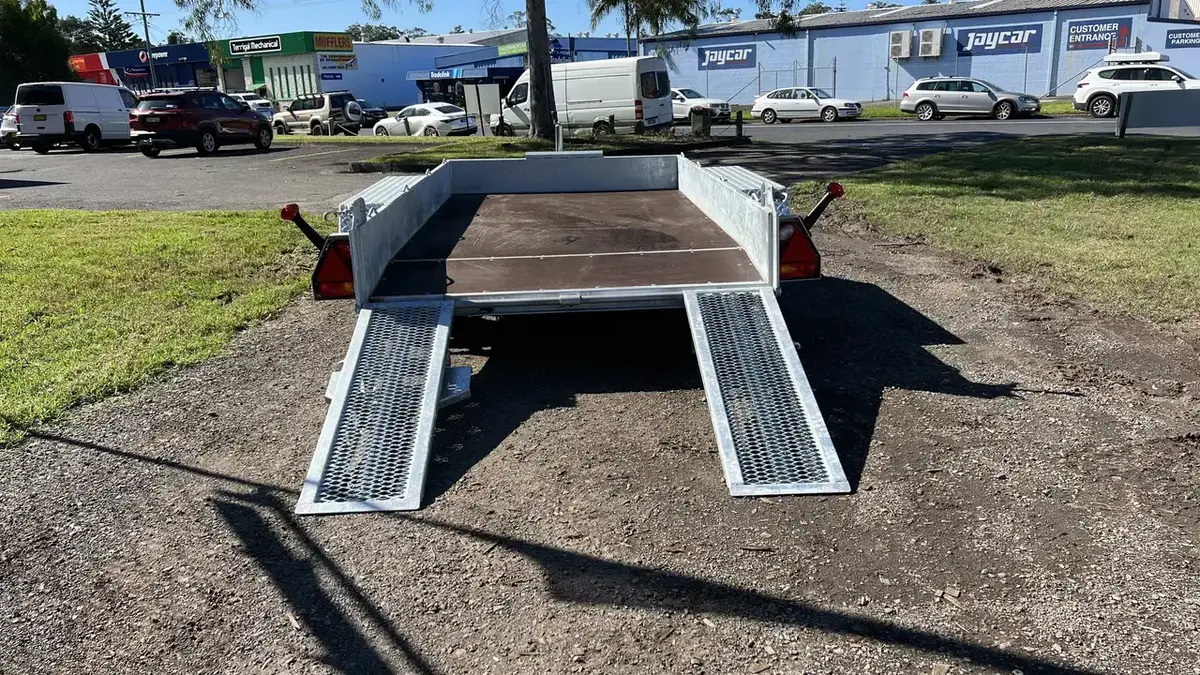
A plant trailer is a flat-deck trailer built to carry self-propelled machinery — excavators, skid steers, scissor lifts, rollers, mini loaders — that is driven or tracked onto the deck rather than lifted on. It is distinguished from a general box or car trailer by three things: a low deck height, a full-width loading ramp or beavertail, and a deck and lashing system rated for concentrated point loads under a machine’s tracks or tyres.
In Australia the practical ceiling is 3,500 kg ATM. Above that the trailer stops being a light trailer, the coupling and chain standards change, and most drivers need a heavier licence and a heavier tow vehicle.12
Why 3.5 tonnes is the line that shapes everything
Almost every design decision on a plant trailer traces back to one number. A trailer with an Aggregate Trailer Mass of 3,500 kg or less sits inside the light-trailer rules in Vehicle Standards Bulletin 1, uses AS 4177 safety chains, accepts a standard 50 mm quick-release coupling, and can be towed on an ordinary car licence behind a vehicle rated to 3,500 kg braked.12 Cross the line and you change category on every one of those points.
That ceiling is also a budget. ATM covers the trailer and everything on it. Subtract the trailer’s own tare and what is left is your machine allowance — and that is where the difference between a well-built trailer and an ordinary one shows up in a way you can actually count.
| Model | Type | Tare | Payload | Deck (L×W) | Load height | Ramp angle |
|---|---|---|---|---|---|---|
| 3516 B3 | Beavertail | 593 kg | 2,907 kg | 3.00 × 1.62 m | 330 mm | 22° |
| 3518 M3 | Tailgate ramp | 730 kg | 2,770 kg | 3.00 × 1.80 m | 380 mm | 17° |
| 3518 B4 | Beavertail | 785 kg | 2,715 kg | 4.00 × 1.80 m | 290 mm | 12° |
Figures published by the Australian distributor.567 Note the trade: the 3518 B4 gives up 192 kg of payload against the 3516 B3 and buys a metre of deck, 40 mm less load height and a ramp angle almost half as steep. Which of those you need is the whole buying decision.
The five shapes a plant trailer comes in
Manufacturers use different names, but under 3.5 tonnes there are really only five loading solutions, and each exists to solve a specific problem with ground clearance, machine length or deck space.
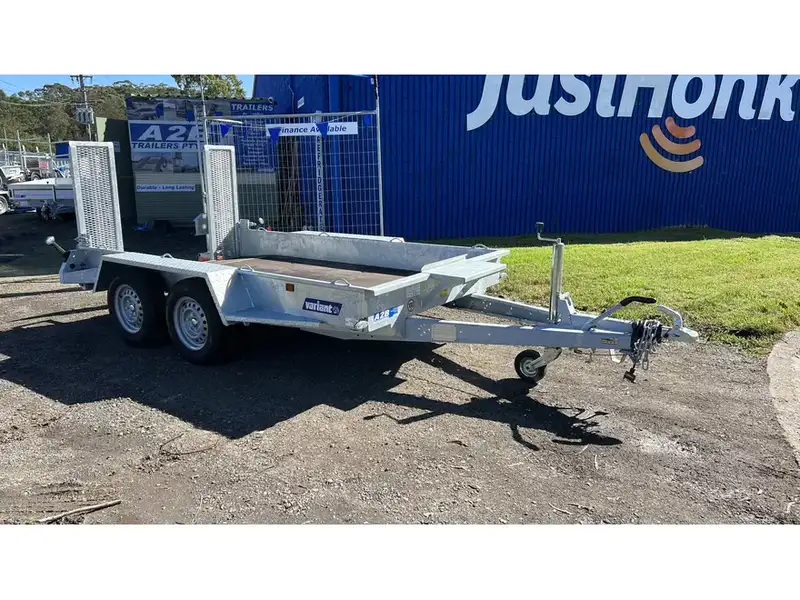
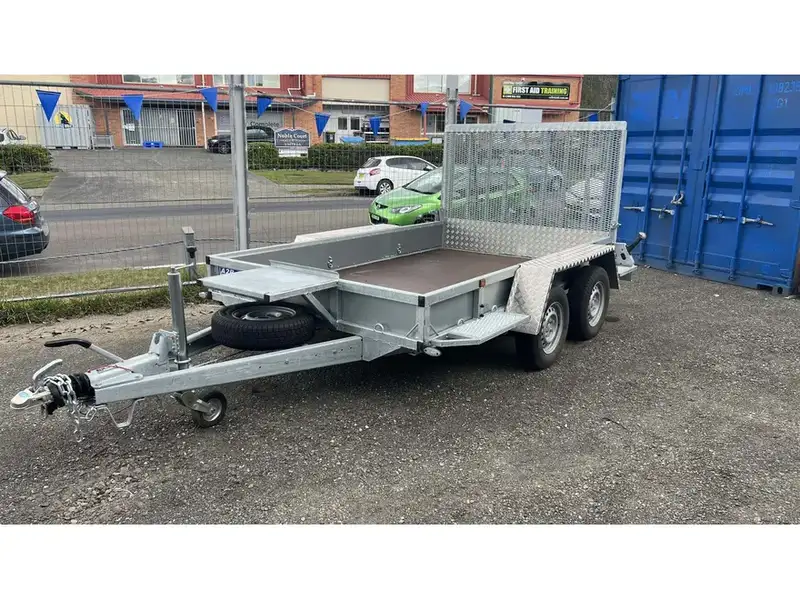


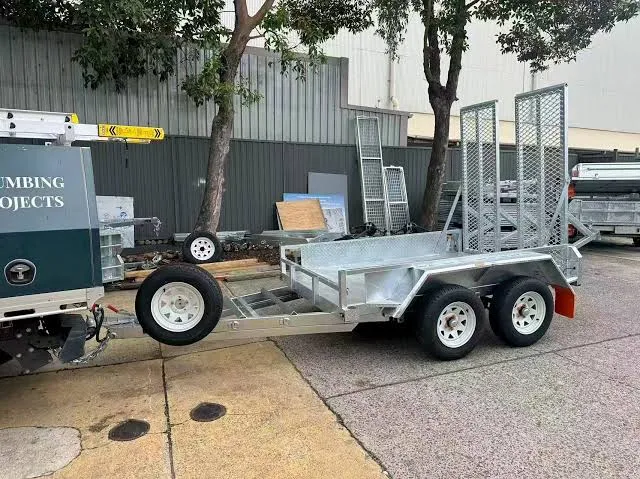
The number that decides it: ramp angle. A machine with 200 mm of belly clearance and a 2.4 m wheelbase will ground out on a 22° ramp and drive cleanly up a 12° one. Before you compare prices, compare the load height and ramp length — those two numbers give you the angle, and the angle decides whether the machine you own can actually get on the trailer. Work through the geometry →
Start here
Seven pages, each answering one part of the question. Read them in order or jump to what you need.
Trailer types explained
Beavertail, tailgate ramp, tilt bed, low loader and drop-side plant bodies — how each one loads, and what it costs you in deck space or payload.
Compare the five types →What machinery actually fits
Published operating weights and track widths for mini excavators, skid steers, scissor lifts, rollers and mini loaders, matched against real deck sizes.
Check your machine →Axles, brakes and couplings
Overrun versus electric brakes, why European trailers use Knott and AL-KO running gear, and what the law requires at each mass band.
Understand the running gear →Loading and load restraint
Ramp angle maths, where to position the machine over the axles, and the 0.8g restraint standard your chains have to meet.
Load it properly →Australian towing law
ATM, GTM, tare and tow ball mass in plain English, licence requirements, safety chains, and the ADRs that apply under 3.5 tonnes.
Stay legal →Buying guide
European versus Australian construction, galvanising, deck materials, lashing systems, and the questions worth asking before you sign.
Buy the right one →Why this site leans European
Plant trailers evolved differently in Europe. Tight sites, narrow lanes, high fuel costs and a regulatory regime built around a 3,500 kg limit pushed manufacturers there to obsess over two things: tare weight and load height. Every kilogram saved in the chassis becomes a kilogram of machine you can carry, and every centimetre the deck drops makes the ramp shallower.
The result is a design language you can see in the numbers — hot dip galvanised chassis rather than painted steel, parabolic leaf springs, sealed bearings, phenolic plywood decks, integrated lashing rails, and mechanical overrun braking with auto-reverse instead of electric brakes and a cab controller.567 A 593 kg tare on a 3,500 kg trailer is a European number.
None of that makes Australian-built trailers wrong. Heavier local builds often win on ruggedness, parts availability in regional areas, and repairability with a welder. This site covers both — it simply starts from the European engineering assumptions because that is where the interesting trade-offs live. The buying guide puts them head to head →
Quick fit check: three common machines
The fastest sanity test is machine operating weight against trailer payload. These are published figures for three machines Australians tow constantly.
| Machine | Operating weight | Width | Fits 2,715 kg payload? | Notes |
|---|---|---|---|---|
| Kubota U27-4 (canopy) | 2,570 kg8 | 1,500 mm | Yes | 145 kg spare. Attachments count — weigh them. |
| Bobcat S450 skid steer | 2,280 kg9 | 1,490 mm | Yes | Comfortable. Watch height with the ROPS up. |
| Genie GS-2632 scissor lift | 2,145 kg10 | 810 mm | Yes | Narrow and long — deck length matters more than width. |
Payload is not the only limit. Your tow vehicle’s braked towing capacity, its maximum tow ball download, and the combination’s GCM all cap the load independently. A trailer rated to 3,500 kg behind a vehicle rated to 2,500 kg is a 2,500 kg combination. The weights, explained →
Frequently asked questions
What is the difference between a plant trailer and a car trailer?
A car trailer is designed to carry a wheeled vehicle of relatively low, evenly distributed mass, usually with long slide-out ramps and a winch. A plant trailer carries self-propelled machinery whose weight is concentrated under tracks or small wheels, so it has a stronger deck, a heavier lashing system, a lower load height and shorter, wider ramps. Many plant trailers can carry a car; comparatively few car trailers can safely carry a 2.5 tonne excavator.
What is the biggest machine I can tow on a car licence in Australia?
The limit is set by trailer ATM, not by the machine. On a standard car licence you can tow a trailer up to 3,500 kg ATM provided your vehicle is rated for it. Subtract the trailer's tare from 3,500 kg to get the machine allowance — typically 2,700–2,900 kg on a good European plant trailer, which covers most mini excavators up to about 2.8 tonnes, compact skid steers, and 26 ft electric scissor lifts.
Do plant trailers need brakes in Australia?
Yes, at plant trailer masses. A trailer over 750 kg GTM must have brakes on at least one axle, and above 2,000 kg GTM it must have brakes on all wheels plus a breakaway system that applies the brakes automatically if the trailer detaches. Every plant trailer worth buying is over 2,000 kg, so all-wheel brakes and a breakaway are mandatory.
Is mechanical overrun braking legal in Australia?
Yes. Overrun (inertia) braking is permitted on trailers up to 3,500 kg ATM and needs no in-cab controller. Above 3,500 kg it is no longer permitted and electric or air brakes are required. European plant trailers overwhelmingly use overrun systems with an auto-reverse mechanism; Australian-built trailers more often use electric brakes.
How much payload does a 3,500 kg plant trailer actually have?
Between roughly 2,700 kg and 2,900 kg on a light European build, and commonly 2,300–2,600 kg on a heavier steel trailer. The published Variant range shows 2,907 kg on the 3516 B3 (593 kg tare) down to 2,715 kg on the longer 3518 B4 (785 kg tare). Always work from the compliance plate, not the brochure.
What ramp angle do I need for a mini excavator?
Most tracked mini excavators will climb a 20–22° ramp without trouble, but low-clearance machines, scissor lifts, rollers and anything on solid tyres want 15° or less. Beavertail designs get down to about 12° because the rear of the deck itself tapers toward the ground rather than relying on a bolted-on ramp.
Sources and further reading
- Vehicle Standards Bulletin 1 (Revision 6) — Trailers with an Aggregate Trailer Mass of 4.5 tonnes or less, September 2024, Australian Government Department of Infrastructure — www.infrastructure.gov.au/sites/default/files/documents/vsb1-revision-6-traile
- Light Trailer Requirements — Compliance with VSB1, Department of State Growth Tasmania — www.transport.tas.gov.au/?a=109707
- Trailer and Tow Vehicle Specifications, RACQ — www.racq.com.au/car/towing/trailer-and-tow-vehicle-specifications
- Plant & Machinery Trailers range, Variant Trailers Australia — variant-trailers.com.au/category/trailers/plant-machinery-trailers/
- Beavertail Trailer 3518 B4 specification, Variant Trailers Australia — variant-trailers.com.au/trailers/beavertail-trailer-3518b4-4-08x1-88m/
- Beavertail machine trailer 3516 B3 specification, A2B Trailers — www.a2btrailers.com.au/trailers/3516b3/
- Tandem plant trailer 3518 M3 specification, A2B Trailers — www.a2btrailers.com.au/trailers/3518m3/
- Kubota U27-4 mini excavator specifications, Kubota Australia — kubota.com.au/product/excavator-u27-4
- Bobcat S450 skid steer loader specifications, RitchieSpecs — www.ritchiespecs.com/model/bobcat-s450-skid-steer-loader
- Genie GS-2632 E-Drive scissor lift specifications, Genie — www.genielift.com/en/aerial-lifts/Slab-scissor-lifts/gs2632
- Loading Guide — Performance Standards, National Heavy Vehicle Regulator — www.nhvr.gov.au/road-access/loading/loading-guides/performance-standards
Figures were checked against the sources above on 2026-08-26. Manufacturer specifications change without notice — confirm weights and dimensions against the current compliance plate and specification sheet before towing.